Comet 3I ATLAS Confirmed As Rare Interstellar Object With Ancient Cosmic Origins
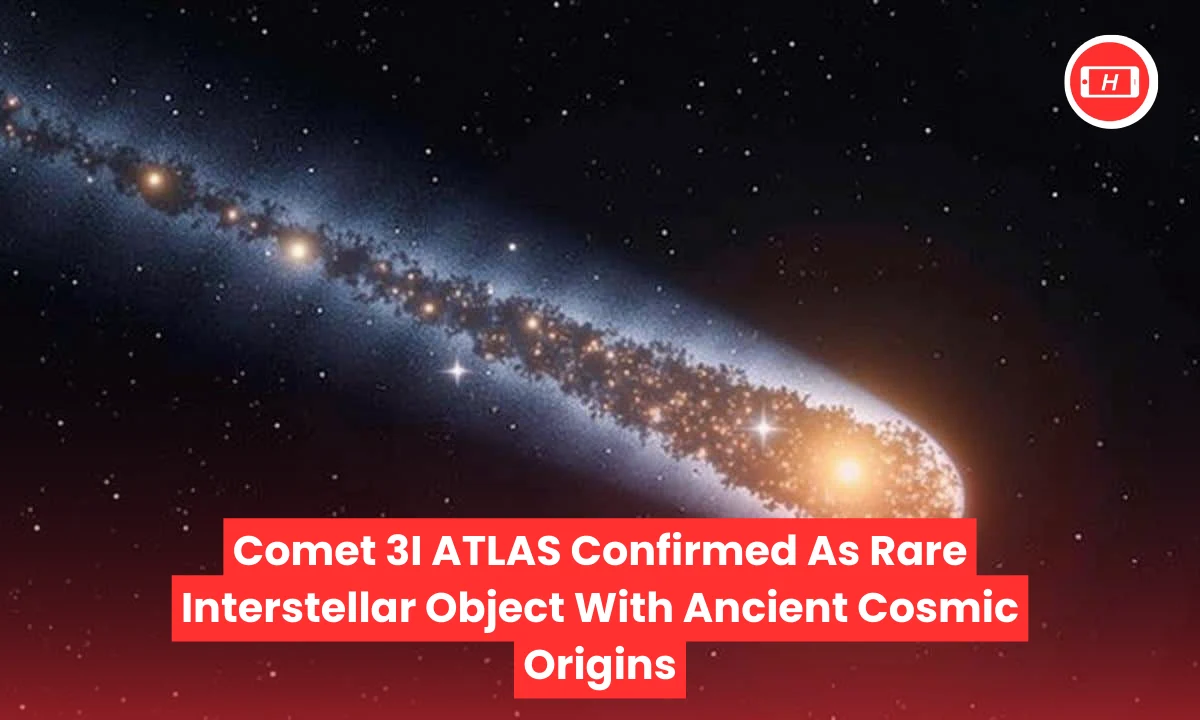
Comet 3I ATLAS Confirmed As Rare Interstellar Object With Ancient Cosmic Origins | Image With Comai Lab
Comet 3I ATLAS is now confirmed as the third interstellar object to enter our solar system. Scientists say it came from outside the Sun’s gravitational system. This means the comet was born in another star environment. The object follows a hyperbolic path. Its speed is very high. So it will not return.
Key Takeaways
- 3I ATLAS is the third confirmed interstellar object ever found
- It likely formed 8 to 14 billion years ago
- The comet contains unusual chemistry not seen in local comets
- Scientists see wobbling jets and rare anti tail activity
- Public reaction mixes science excitement and alien speculation
Also Read: CUET UG 2026 Registration Begins: Key Dates, Eligibility, Syllabus Updates And Public Response
The comet reached its closest point to Earth on December 19, 2025. The distance was about 1.8 AU. That is more than 270 million kilometers from our planet. The closest point to the Sun happened on October 29, 2025 at 1.36 AU. The comet is now fading in brightness as it moves outward again.
A Visitor Older Than Our Sun
Studies suggest that 3I ATLAS may be between 8 and 14 billion years old. If true, this means the comet existed before the Sun was born. Our Sun formed around 4.6 billion years ago. So this object may hold untouched material from the early universe. That makes the comet one of the oldest physical samples ever seen.
The comet is estimated to have a nucleus between 0.4 and 5.6 kilometers across. Researchers believe it is rich in frozen carbon dioxide, water ice and dust. Scientists also detected atomic nickel without similar iron levels. This makes the comet chemically unique when compared to standard solar system comets.
Interstellar Origins Confirmed By Its Path
Astronomers confirmed the object as interstellar through its motion. The orbit is hyperbolic with eccentricity above 1. This means gravity from the Sun cannot capture it. Its inbound speed was about 58 km per second. This is far higher than most local comets.
The comet will pass near Jupiter at about 0.36 AU on March 16, 2026. After that it will leave the solar system forever. It is not a danger to Earth.
Strange Jets And A Rare Anti Tail
Images from major observatories show strong activity around the comet. These include Hubble, Gemini, Subaru, and the Very Large Telescope. Scientists see complex jets of gas and dust from the nucleus. The jets appear to wobble as the body spins. The rotation period is around 16 hours.
One jet points toward the Sun and forms what is called an anti tail. This can happen when dust spreads in a way that makes part of the tail appear ahead of the comet. The anti tail seen in 3I ATLAS is very long and thin. This structure and the symmetry of the jets have drawn wide attention.
Strong Scientific Interest
The comet shows high water production even after passing the Sun. It also releases cyanide gas and other chemicals. These signals help scientists understand its origin region. The unusual chemistry suggests formation in a very cold zone around a distant star.
Spacecraft such as the Parker Solar Probe, Europa Clipper, and JUICE have also observed it. The data set collected is one of the largest ever for an interstellar visitor.
Public Reaction And Ongoing Debate
Interest on social media is intense. Many users admire telescope images that show a glowing green coma and sharp jets. People often describe the comet as a cosmic messenger. Amateur astronomers are also sharing their own images.
At the same time, a small number of users claim the object may not be natural. Some say the jets look like engines or thrusters. Others speak about signals or hidden technology. Radio scans have been done. They show no artificial transmission. Scientists say the object behaves like a comet. There is no confirmed technology.
Mainstream science agrees that the comet formed naturally.
Current Status In Early January 2026
As of now the comet is fading to magnitude 11 to 12. It is still visible in telescopes. Ongoing activity continues. The jets remain strong. There is no sign of breakup. The object continues to behave like a stable comet.
What Makes 3I ATLAS Important
This comet offers a direct sample of building material from another star system. Most exoplanet research comes from distant light data. Here scientists can study physical dust and gas that passed through our neighborhood.
Future research will look at:
- How interstellar comets form
- What kind of stars create them
- Whether exotic chemistry is common in other systems
- How often such visitors arrive
One Listicle: Key Scientific Highlights Of 3I ATLAS
- It is the third confirmed interstellar object after Oumuamua and Borisov
- It may be older than the Sun by billions of years
- It shows strong jets that shift with rotation
- It contains rare nickel vapor with unusual chemistry
- It follows a hyperbolic path and will never return
No Threat To Earth
The comet stays far from our planet. Closest approach already passed. There is no collision risk. The Jupiter flyby also does not place the object on a path toward Earth.
A Historic Astronomical Event
3I ATLAS represents one of the most important space discoveries of the decade. It confirms that wandering interstellar comets are more common than once believed. With new sky surveys such as the Vera Rubin Observatory, more such visitors will likely be found.
This comet blends scientific mystery with public curiosity. It inspires new questions about the universe. It also reminds us that our solar system is part of a larger galactic environment. As the comet now travels back into deep space, it leaves behind a powerful scientific legacy.
Tags: interstellar object, comet 3I ATLAS, space science, astronomy news, solar system, nasa research
Related Posts :






Share This Post