Sunita Williams Retires After 27 Years, Closing A Historic Chapter In Space Exploration
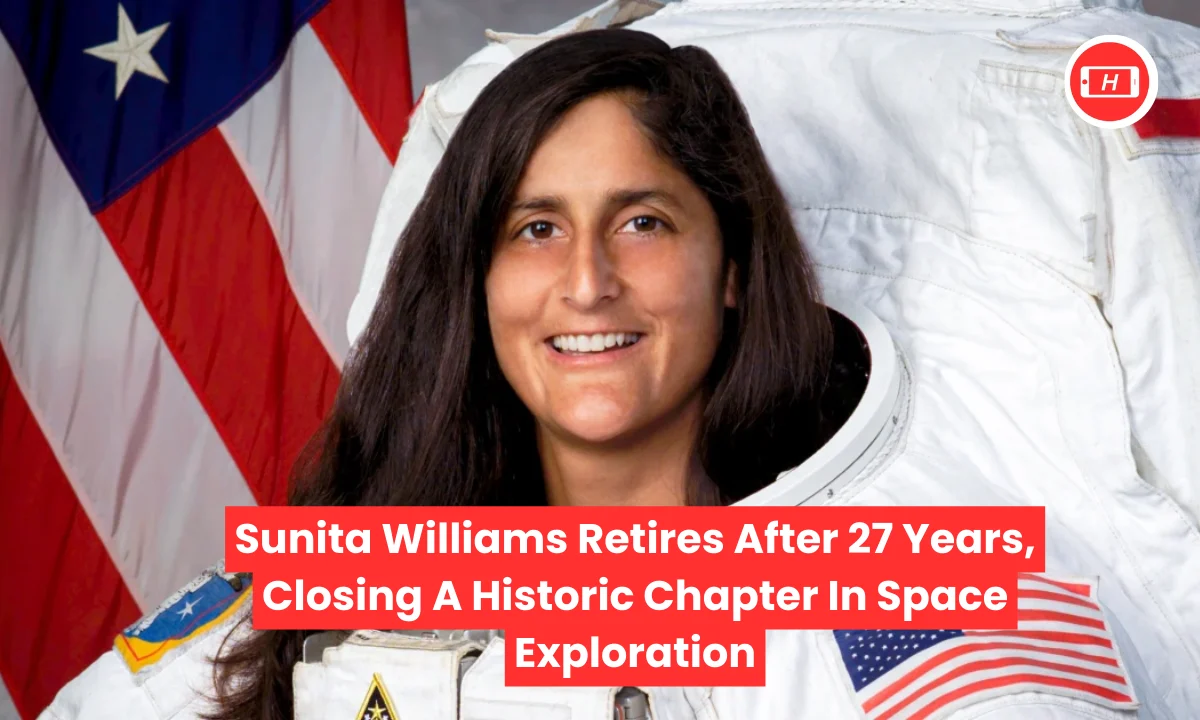
Sunita Williams Retires After 27 Years, Closing A Historic Chapter In Space Exploration | Image Via NBC News
Sunita Williams has officially retired from NASA, bringing an extraordinary 27 year career to a close. Her retirement took effect on December 27, 2025, and the announcement in January 2026 has triggered global attention, admiration, and pride, especially in India and among the Indian origin community worldwide.
Coming less than a year after her safe return from space in March 2025, the timing of her retirement feels symbolic. It marks the completion of a journey defined by endurance, leadership, and scientific contribution. For many, this moment is not just about retirement, but about celebrating one of the most influential astronauts of modern spaceflight.
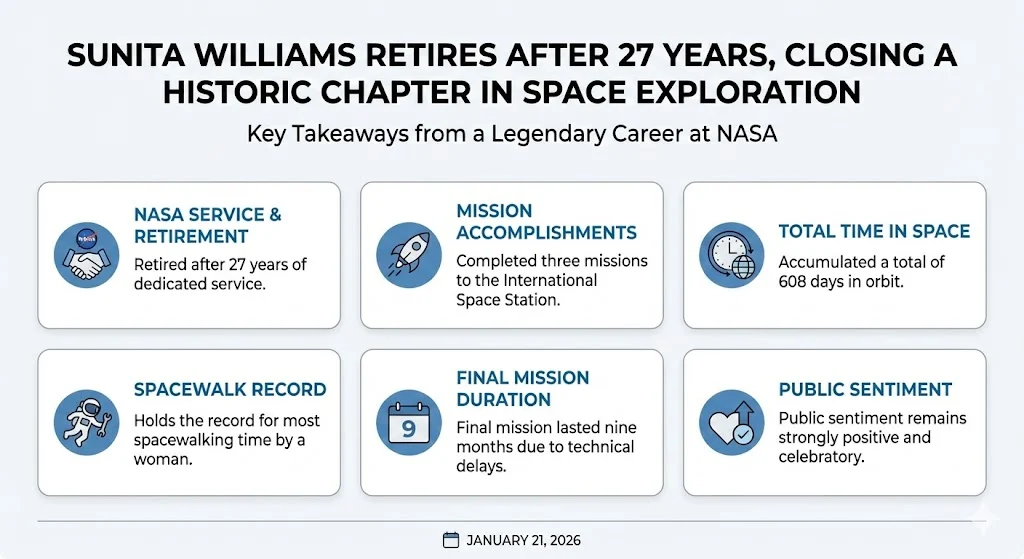
Table of Contents
Key Takeaways
- Sunita Williams retired from NASA after 27 years of service
- She completed three missions to the International Space Station
- Her total time in space reached 608 days
- She holds the record for most spacewalking time by a woman
- Her final mission lasted nine months due to technical delays
- Public sentiment remains strongly positive and celebratory
Also Read: Deepinder Goyal Steps Back From The Corner Office As Eternal Enters A New Phase
A Career Shaped By Dedication & Discipline
Sunita Williams joined NASA in the late 1990s and steadily built a reputation as a reliable and skilled astronaut. Over nearly three decades, she became known for her calm approach, technical precision, and ability to lead under pressure. Her work was not limited to spaceflight alone. She also played a key role in training future astronauts and supporting evolving mission programs.
During her career, she participated in three long duration missions aboard the International Space Station. Each mission added to her experience and reinforced her position as a central figure in human space exploration. By the time she retired, she had become one of the most experienced astronauts NASA has ever produced.
Her journey reflects consistency rather than sudden success. Every mission built upon the last, and every challenge strengthened her resolve. This steady rise is a key reason why her retirement is being viewed as the conclusion of a legacy rather than a simple career exit.
Record Setting Achievements In Orbit
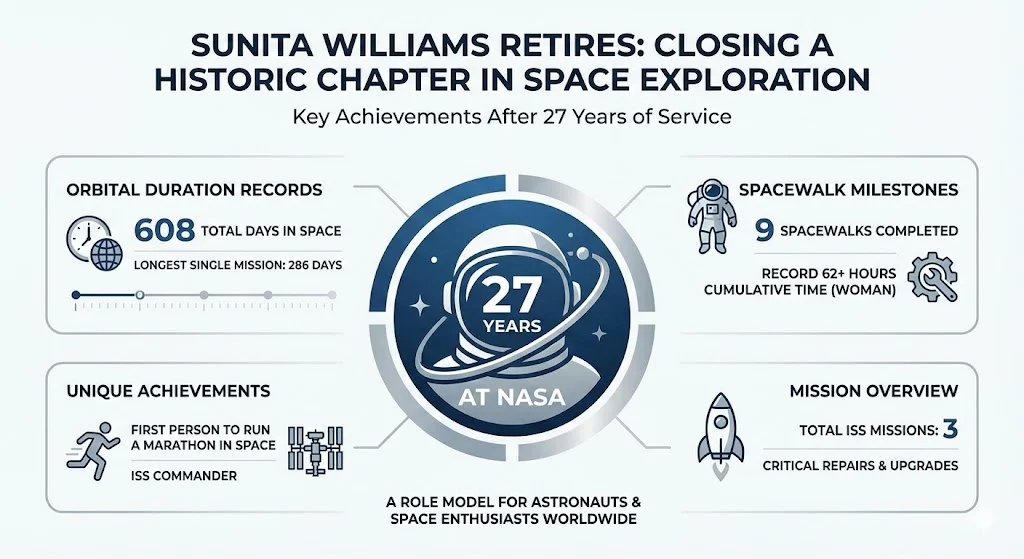
Sunita Williams leaves behind numbers that speak clearly about her impact. She logged a total of 608 days in space, placing her among the most experienced astronauts in NASA history. This achievement alone puts her in a rare category, but her records extend further.
She completed nine spacewalks during her missions. The total time she spent outside the spacecraft exceeded 62 hours, making her the woman with the highest cumulative spacewalking time. These spacewalks were not symbolic. They involved complex repairs, maintenance tasks, and upgrades that were critical to the station’s operation.
She also became the first person to run a marathon in space, a moment that captured public imagination and highlighted the physical discipline required for long duration missions. Each of these achievements added to her standing as a role model for astronauts and space enthusiasts alike.
Overview of Sunita Williams’ spaceflight record
| Category | Details |
|---|---|
| Years at NASA | 27 years |
| Total ISS missions | 3 |
| Total days in space | 608 days |
| Longest single mission | 286 days |
| Spacewalks completed | 9 |
| Total spacewalk time | 62 hours 6 minutes |
| ISS commander | Yes |
The extended mission that defined resilience
Her final mission began in June 2024 aboard Boeing’s Starliner spacecraft. What was planned as a short test mission soon turned into an extended stay due to technical issues with the vehicle. Instead of returning in days, Sunita Williams and fellow astronaut Butch Wilmore remained aboard the ISS for nearly nine months.
Throughout this period, Williams consistently addressed concerns with clarity and calm. She publicly stated that she did not feel stranded or abandoned. She described the situation as part of exploration and problem solving, a mindset that earned widespread respect.
The mission finally concluded in March 2025, when the astronauts returned safely to Earth aboard a SpaceX Crew Dragon spacecraft. The successful return shifted public discourse from concern to admiration, reinforcing her image as a professional who handled uncertainty with confidence.
Leadership aboard the International Space Station
Sunita Williams also served as commander of the International Space Station, a role that carries immense responsibility. As commander, she was responsible for crew safety, mission coordination, and communication with ground teams across multiple countries.
Her leadership style was often described as practical and inclusive. She worked closely with international astronauts, reinforcing the ISS as a symbol of global cooperation. This aspect of her career is frequently highlighted in tributes, as it reflects her ability to lead beyond technical skills.
Her command period further strengthened her reputation as a trusted figure within NASA and partner agencies. It also demonstrated the expanding role of women in leadership positions within space programs.
Indian roots and global inspiration
Sunita Williams’ heritage has always been a point of connection for many in India. Her father was born in Gujarat, and she has spoken openly about her emotional bond with the country. During her visits to India, she often referred to them as homecomings rather than formal trips.
In recent public appearances in India, including academic institutions, she spoke about how viewing Earth from space changes perspective. She explained that from orbit, borders disappear and conflicts seem less meaningful. These reflections resonated strongly with audiences and were widely shared on social platforms.
Her words were not motivational slogans. They were grounded observations shaped by experience. This authenticity is one reason why she is viewed as a genuine role model rather than a distant figure.
Public Sentiment & Global Response ( Data Taken From X )
The announcement of her retirement has triggered an overwhelmingly positive response. Social media platforms are filled with tributes calling her a legend, a trailblazer, and a source of pride. In India, she is often referred to as an Indian space hero, even though her career unfolded within NASA.
Messages from fellow astronauts, scientists, educators, and students reflect gratitude rather than nostalgia. Many highlight her contribution to encouraging young women to pursue careers in science and engineering.
NASA leadership has also acknowledged her role in shaping future missions, especially during a time when commercial spaceflight is becoming more prominent. Her experience across multiple spacecraft programs is seen as a bridge between traditional and modern space exploration.
Minimal criticism and balanced perspective
Criticism around Sunita Williams’ career is rare and largely indirect. During the extended 2024 mission, some concerns were raised about health effects related to microgravity. These discussions were short lived and quickly overshadowed by relief after her safe return.
Any frustration linked to the Starliner delays was directed at technical challenges rather than at the astronauts themselves. Williams’ professional conduct during this period helped maintain public trust and respect.
Overall, the narrative around her retirement remains focused on achievement, resilience, and inspiration rather than controversy.
What her retirement represents
Sunita Williams’ retirement represents more than the end of a career. It marks the close of a chapter in which astronauts spent decades mastering systems, building institutions, and setting standards for future explorers.
Her career spanned shuttle missions, long duration ISS stays, and the transition into commercial spacecraft. Few astronauts have experienced such a wide range of programs. This makes her insights valuable even beyond active service.
As discussions grow around her possible future roles in advisory or educational capacities, one thing remains clear. Her influence will continue, even outside the astronaut corps.
A legacy that will endure
Sunita Williams leaves NASA with a legacy defined by service, humility, and achievement. Her records may eventually be surpassed, but the way she conducted herself under pressure will remain a reference point.
For young students, especially girls interested in science and technology, her journey offers a clear message. Progress comes through discipline, patience, and belief in long term goals.
As space exploration enters a new era, the foundation laid by astronauts like Sunita Williams will continue to support future missions. Her retirement is not an ending, but a milestone in a story that will inspire generations.
Tags: Sunita Williams, NASA astronaut, women in space, Indian origin astronaut, ISS missions, space exploration
Related Posts :




Share This Post